

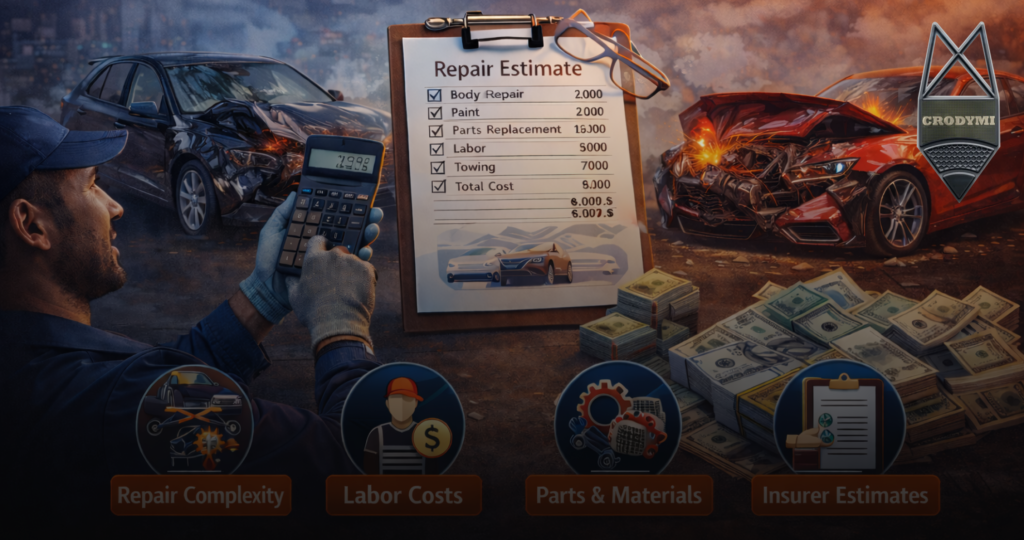
A car accident can feel overwhelming, even before you start thinking about repairs. The first thought that most people immediately have is how much it will cost to fix their car. While many assume repair pricing is clear-cut, real estimates involve more than just what you can see, like dents or broken lights. Thorough analysis and expert assessment all play a role in finding a fair price.
Getting an accurate vehicle repair cost estimation does more than just save you money. It can speed up insurance claims, help you avoid underpaid repairs, and make things clearer if there’s a dispute. Without a solid process, repair costs can vary widely, which may leave drivers with unexpected bills or unresolved claims.
This guide explains how repair costs are calculated after an accident, what affects pricing, and how forensic data can improve accuracy. You’ll see how professionals perform accident damage assessment, why modern cars need a closer look, and how using data helps reduce guesswork. If you’ve ever wondered about a repair bill or insurance estimate, this guide is for you.
Why Accurate Repair Estimates Matter After an Accident
Repair estimates are important because they cover more than just parts and labor. They impact insurance payments and legal outcomes. If details are missed, hidden damage can cause problems later. Accurate estimates help build trust and guide insurance payouts. In disagreements, lawyers may use these estimates as a financial guide for fixing your car. Modern cars are complicated, with sensors and computers that can be damaged in ways you can’t see. If these problems are missed, repairs might look fine but could fail when you drive.
Factors That Influence Vehicle Repair Costs
No two accidents lead to the same repair costs. Even similar crashes can have very different estimates because of many aspects. Understanding factors influencing repair costs helps car owners notice problems and ask the right questions.
| Factor | Impact on Repair Cost |
| Vehicle make and model | Influences the parts and expertise required |
| Damage severity | Determines repair complexity |
| Labor rates | Vary by location and technician skill |
| Parts availability | Affects cost and repair timeline |
| Insurance coverage | Impacts out-of-pocket expenses |
The Significance of Comprehensive Accident Damage Assessment
A full accident damage assessment looks deeper than what you can see. Technicians often take apart parts of the car to check hidden components. This helps find damage that might not show up until later.
Suspension misalignment, cracked mounts, and compromised welds can all hide beneath intact body panels. Advanced vehicles also store electronic fault codes after a collision. Reading these codes provides insight into system failures that physical inspections may miss.
If this step is skipped, you might get extra estimates later, which can slow down repairs and make claims more complicated. Doing a thorough assessment at the start saves time, reduces arguments, and leads to more accurate costs.
The Role of Data in Modern Repair Estimation
Data has changed the way repair estimates are made. Today, professionals use databases that track labor times, part prices, and manufacturer instructions. These systems help make estimates more consistent and transparent.
Insurance companies and repair shops often use standard platforms to create estimates. These tools make the process faster, but they still need accurate information. If inspections are not done well, even the best software can give wrong results.
This is where forensic analysis adds value. When disputes arise, independent experts examine vehicle data, damage patterns, and collision dynamics to validate or challenge estimates. Their findings often clarify whether costs reflect real damage or inflated assumptions.
Reasons Initial Estimates Can Fall Short
Many drivers get an initial estimate that looks fair, but then see costs go up as repairs continue. This usually happens because the first estimate is based on limited information.
Repair shops might skip taking things apart during the first inspection to save time. Insurance adjusters may use photos instead of checking the car in person. These shortcuts can lead to misidentifying damage to internal parts, safety systems, or the car’s structure.
Getting a new, higher estimate later can be frustrating, but it usually means new damage was found, not that someone is being dishonest. Knowing how this works helps drivers have more realistic expectations about estimates.
Why Independent Analysis Matters in Complex Cases
When repair costs go up, or there’s a disagreement about who is responsible, an independent analysis can help. Third-party experts look at the evidence without influence from insurance companies or repair shops. Their main goal is accuracy, not controlling costs.
Independent reviews often involve deeper inspection, data retrieval from vehicle systems, and comparison against manufacturer repair standards. This strategy is especially useful in high-value claims or legal cases where exacting documentation matters. Drivers, attorneys, and organizations rely on this objectivity to support negotiations and resolve disagreements efficiently.
The Importance of Forensic Data Retrieval in Accident Reconstruction
Forensic data retrieval brings a scientific approach to figuring out repair costs. It links the physical damage to measurable evidence from the car. This helps experts understand how the damage happened and which repairs are needed.
Vehicle systems record valuable information before, during, and after a crash. Speed, braking, steering input, and airbag deployment all leave digital traces. When reviewed correctly, this data confirms impact severity and damage plausibility. Forensic data also supports a reliable crash estimate through expert validation, regardless of whether the reported damage corresponds to recorded crash dynamics.
How Forensic Data Impacts Legal Cases
Forensic findings often play a decisive role in legal disputes. Courts value objective data that explains events clearly. When repair costs are challenged, forensic analysis can demonstrate why specific repairs are necessary.
Attorneys often use accident reconstruction reports to support claims about injury severity, vehicle damage, or who is at fault. These reports turn multifaceted data into clear conclusions, making it easier for judges and juries to understand the details. Good documentation also helps avoid long disputes, saving time and resources for everyone.
Key Sources of Forensic Data in Vehicle Accidents
Forensic analysis uses several sources of data. Event Data Recorders collect crash information. Vehicle control modules record fault codes and how systems behaved. Outside evidence, like road marks and how the car was damaged, also helps explain what happened.
A crash history report gives extra context by showing any previous damage that might affect current repairs. Using all these sources together gives a complete picture of the accident and how it really affected the car.
How Accident Reconstruction Can Improve Insurance Claims
Insurance claims can get delayed when the facts aren’t clear. Conflicting stories, incomplete inspections, or only looking at the surface can slow things down and cause frustration. Accident reconstruction helps by linking physical evidence with verified data, making it easier for insurers to see what happened and why certain repairs are needed.
Reconstruction analysis helps create accurate car repair quotes after an accident by showing how the impact moved through the car. This makes it easier for insurers to tell the difference between cosmetic damage and more serious structural or safety repairs. When the evidence is consistent with the repair costs, settlements happen faster and with fewer arguments.
Role of Crash Data in Insurance Settlements
Crash data works like a neutral witness. Car systems record important moments before and during a crash, giving details about speed, braking, and how hard the impact was. When this information supports the repair recommendations, insurers feel more confident in the estimate.
Claims that are supported by solid data face fewer challenges. Adjusters can see how the damage coincides with the recorded forces, which means less guessing. This also helps protect car owners from being underpaid because of missed or undervalued damage.
How Accurate Accident Reconstruction Reduces Disputes
Disputes often happen when people see the damage differently. Accident reconstruction replaces opinions with facts that can be measured. When physical damage matches the data, disagreements become less common.
Clear documentation cuts down on back-and-forth and speeds up claims. When reconstruction results support the repairs, insurers and car owners can settle things more quickly.
Understanding Black Box Data Analysis for Vehicle Accidents
Modern cars keep important crash data in onboard systems called black boxes. These systems record important information that helps explain how an accident happened. Analyzing black box data is important for checking if repair costs are fair. It shows if the damage matches what happened in the crash.
What is Black Box Data and How is it Retrieved?
Black box data, also known as Event Data Recorder information, captures data points such as speed, throttle position, seatbelt use, and airbag deployment. Trained professionals retrieve this data using specialized tools that preserve integrity.
Getting this data out correctly requires strict procedures. If the data is handled poorly, it can get corrupted or cause legal problems. That’s why trained experts always follow standard steps when extracting and analyzing the data.
How Black Box Data Supports Accident Investigations
Black box data strengthens investigations by providing objective evidence. It helps explain why certain components failed or why damage spread in a particular pattern. When paired with physical inspections, black box data confirms repair necessity. This combination strengthens estimates and reduces uncertainty during insurance reviews or legal evaluations.
Key Tools and Techniques in Forensic Accident Reconstruction
Forensic reconstruction uses advanced tools to make the analysis accurate and repeatable. These tools turn raw data into clear visuals and numbers. With these methods, experts can validate the accident damage assessment findings and see if repair recommendations match what really happened.
Advanced Software for Accident Reconstruction
Reconstruction software lets experts model how a vehicle moved, the angle of impact, and how forces were distributed. These programs combine crash data, car details, and scene evidence into one analysis. The results help explain what caused the damage, which is especially useful when repairs are complicated or expensive.
The Role of Simulation and Modeling in Forensic Analysis
Simulations let experts recreate accidents in a digital setting. This way, they can test scenarios and compare the results to real evidence. Modeling shows why some repairs can’t be avoided and explains how energy from the crash affects parts of the car you can’t see. This helps make accident repair cost breakdowns more accurate.
How EDR Data Helps in Accident Investigations
Event Data Recorder data gives a snapshot of how the car was behaving just before a crash. This information helps experts judge how severe the impact was and how the car’s systems responded. EDR findings often connect what you see on the outside with hidden mechanical or electronic damage.
What EDR Data Can Reveal About an Accident
EDR data shows things like braking, acceleration, and how well safety systems worked. These details explain how the car responded and why some systems turned on or failed. This information helps support repair estimates by proving that safety systems were stressed and may need to be checked or replaced.
Legal Considerations When Using EDR Data in Court
All courts expect EDR data to be handled carefully. Keeping a clear record of who handled the data and how it was stored makes it acceptable in court. When used correctly, EDR findings are strong evidence. Lawyers use this data to support claims about damage value, who is at fault, and safety rules.
How to Interpret Crash Data for Accident Reconstruction
Understanding crash data takes both technical skill and knowing the context. Numbers by themselves don’t tell the whole story. Experts look at the data along with physical evidence and the accident scene. Interpreting it correctly leads to reliable estimates and avoids mistakes about how bad the damage is.
The Process of Analyzing Crash Data
Analysis starts with simple data accuracy checks. Experts need to extract the data before comparing it to the car’s damage and the accident scene. Looking at several sources makes the findings stronger and reduces mistakes.
Common Pitfalls to Avoid in Crash Data Analysis
Misinterpreting data can lead to flawed conclusions. Here are some pointers:
| Pitfall | Why It Matters |
| Misinterpreting crash data | Leads to incorrect conclusions |
| Ignoring vehicle specifications | Causes inaccurate analysis |
| Overlooking prior damage | Skews repair and impact findings |
| Relying on a single data point | Weakens overall accuracy |
Legal Aspects of Forensic Data in Accident Reconstruction
Judicial review in small claims courts demands precision. Forensic data must meet standards of reliability and transparency. When handled correctly, it strengthens claims and supports fair outcomes.
Admissibility of Forensic Data in Court
Courts tend to look at how the data was collected, stored, and examined. When the right forensic methods are used and record keeping is done perfectly, it aids in getting the data accepted. Experts explain their findings in simple terms. Reliable data can make legal cases shorter by making the facts clear early on.
How to Ensure the Integrity of Forensic Data
Keeping data safe means storing it securely, keeping detailed records, and limiting who can access it. Experts follow the strict rules outlined by governing bodies to protect the evidence from being changed.
Why Professional Insight Matters for Accurate Repair Costs
Estimating repair costs takes more than just following a checklist. It needs technical know-how, the ability to interpret data, and an objective view. Independent experts make sure estimates show the real damage, not just guesses.
If you’re dealing with a complicated claim or dispute, a professional analysis can give you peace of mind. Clear evidence helps people make informed choices and reach fair solutions.
When accuracy is important, working with specialists who turn complex evidence into clear advice can make a big difference. Many organizations look to Crodymi LLC for expert analysis and support when they need clear answers about vehicle damage.
Conclusion
Obtaining an accurate repair estimate after an accident is critical for safeguarding your safety, finances, and legal rights. A reliable estimate must encompass both visible and hidden damage, supported by concrete data. Understanding how inspections, forensic analysis, and reconstruction collaborate is essential for both car owners and professionals. Employing data-driven methods is imperative to minimize confusion and disputes. When estimates are anchored in real evidence, the outcomes become clearer and more equitable for all parties involved.
Frequently Asked Questions
1. Why do repair estimates change after initial inspections?
This happens because most unseen damage frequently reveals itself only after disassembly. New insights compel us to adjust our estimates, ensuring they truly reflect the genuine requirements for repair.
2. How long does a professional repair estimate take?
The timelines for such estimates vary based on damage severity. Complex cases requiring thorough data analysis may take longer for the sake of accuracy.
3. Can forensic analysis help challenge an insurance estimate?
Definitely, Independent forensic analysis can easily validate or dispute estimates. It ultimately falls on the strategic usage of objective data and documented evidence.
4. Is black box data always available after an accident?
Not really. The availability of the black box data depends on vehicle make, model, and system condition.
5. How does reconstruction benefit non-legal cases?
Reconstruction clarifies damage causation, supporting fair insurance settlements and accurate repairs.