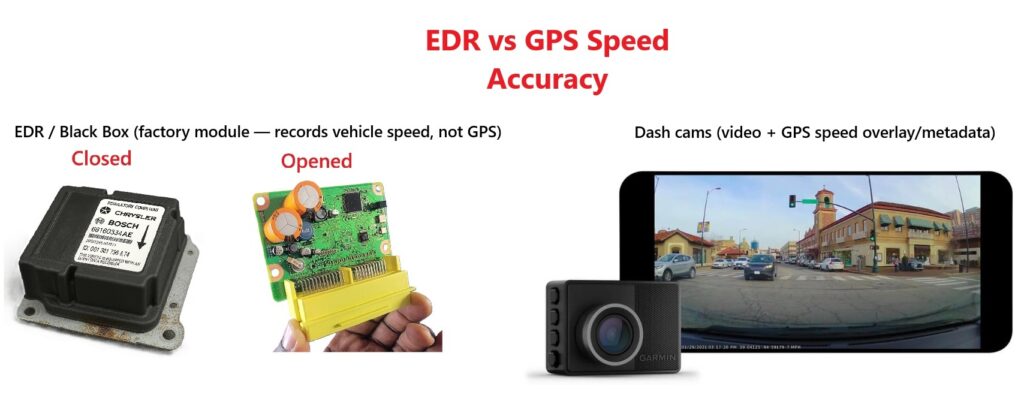
Event Data Recorders (EDRs) are factory-installed devices that record a snapshot of vehicle and occupant data during a crash, while GPS trackers are aftermarket devices used by consumers or fleets to track vehicle location and driving habits in real time. The fundamental difference lies in their purpose: EDR = accident reconstruction; GPS = monitoring & security.
| Feature | Event Data Recorder (EDR) | GPS Tracker |
|---|---|---|
| Primary purpose | Gathers vehicle/occupant data briefly before, during, and after a crash. | Provides real-time & historical location, speed, and movement. |
| Who uses it | Law enforcement, insurance investigators, safety researchers. | Individuals (family safety/theft) & businesses (fleet management). |
| Installation | Factory-installed (airbag/PCM). If installed, vehicles built after Sep 1, 2012 must meet EDR standards. | Aftermarket: hardwired, OBD-II plug-in, or battery-powered. |
| Data collection | Triggered by impact/rapid ΔV; event-based snapshot. | Continuous or interval-based; uploads via cellular network. |
| Type of data | Speed, braking, accel, RPM, steering, belt status, airbag timing. | Location, speed, heading, trip distance, geofence alerts. |
| Data retrieval | Requires CDR tools & trained professionals. | Viewed in app/web portal; no special tools needed. |
| Data privacy | Not continuously transmitted; access post-incident by authorized parties. | Continuous transmission; user/admin controls visibility & retention. |
| Accuracy (speed) | Very accurate, high-frequency internal sensors seconds before impact. | Less precise at a moment in time; speed derived from spaced GPS fixes. |
Which is more reliable for speed at impact?
For crash physics, EDR generally provides superior moment-in-time speed and timing (brake/throttle/airbag sync). GPS can under- or over-state instantaneous speed due to sampling intervals, signal blockage (tunnels/urban canyons), or latency—but it’s excellent for route and behavior context.
- Best practice: Use both: EDR for the event, GPS for trip context.
- Chain of custody: Preserve EDR modules & document transfers; export GPS data with platform logs.
- Consent & authority: Ensure proper legal authorization before accessing either dataset.
- Corroboration: Cross-check timestamps (EDR/airbag time, GPS server time, phone/camera time).
Related
Dashcam vs EDR — What’s the Difference?
How dash video complements black-box data.
Services
EDR / Black-Box Data Retrieval
On-site download, preservation, reporting.
Visualization
Forensic Animation & EDR Integration
Turn data into persuasive visuals.
Devices
Browse Trusted GPS Trackers
OBD-II and hardwired options.
Get started
Start the process today — no upfront payment required. We’ll provide the service now, and you can settle the payment later.
Tell us what you need
Get updates & continue
Drop your email so we can follow up. You can skip if you prefer.
EDR vs GPS Speed Accuracy: Which Data Wins in Accident Reconstruction?
Quick take: Vehicle black box data (EDR) captures high-frequency pre-crash speed and control inputs, while GPS logs speed less frequently. In insurance disputes, both can be credible—but only when analyzed side-by-side by a qualified expert.
A recent discussion on CrashForum.info raised a common dispute: a driver’s GPS tracker showed 80–90 km/h, but the vehicle’s Event Data Recorder (EDR)—the onboard “black box”—reported 148 km/h before impact. Which dataset should you trust?
What Is an EDR (Black Box)?
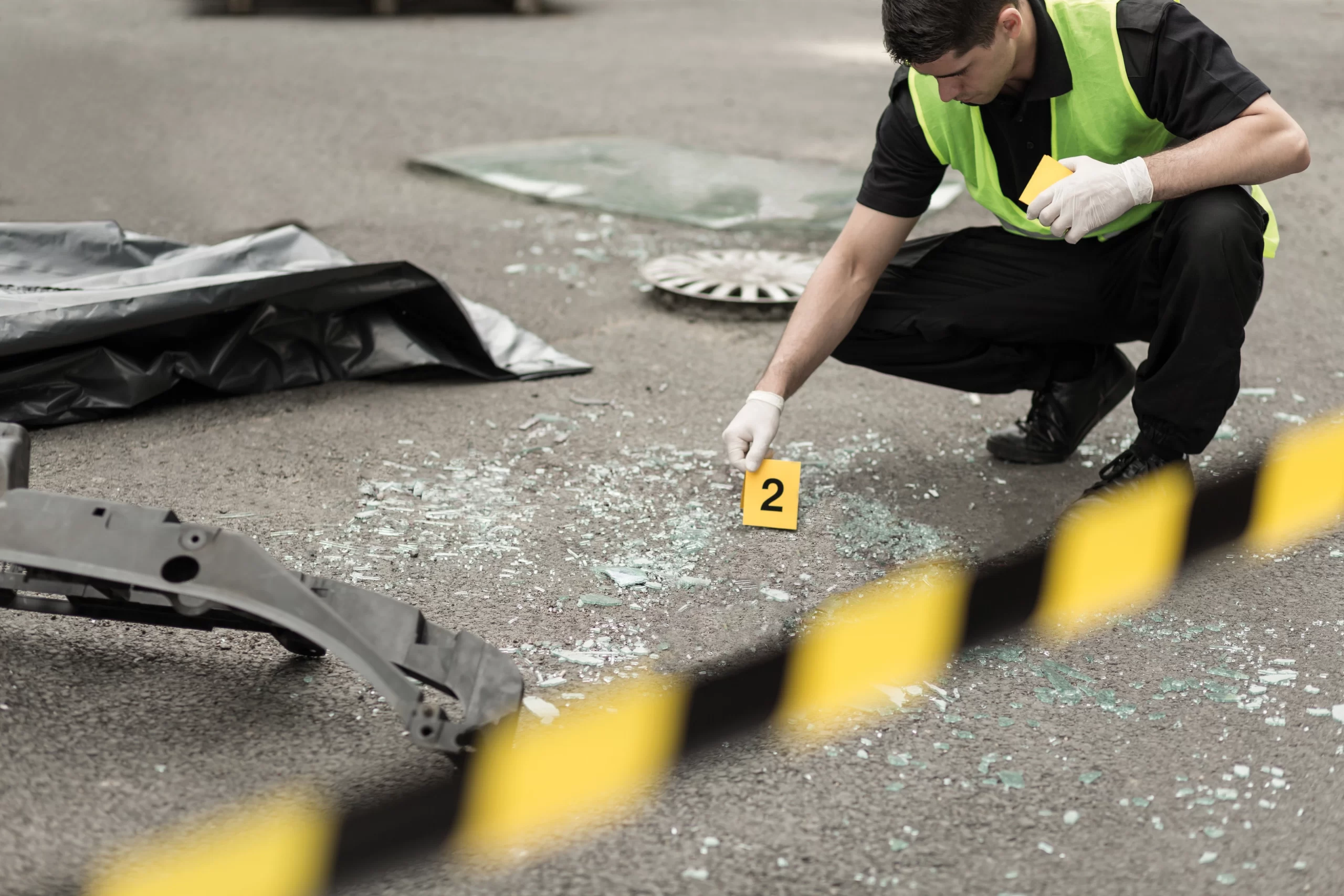
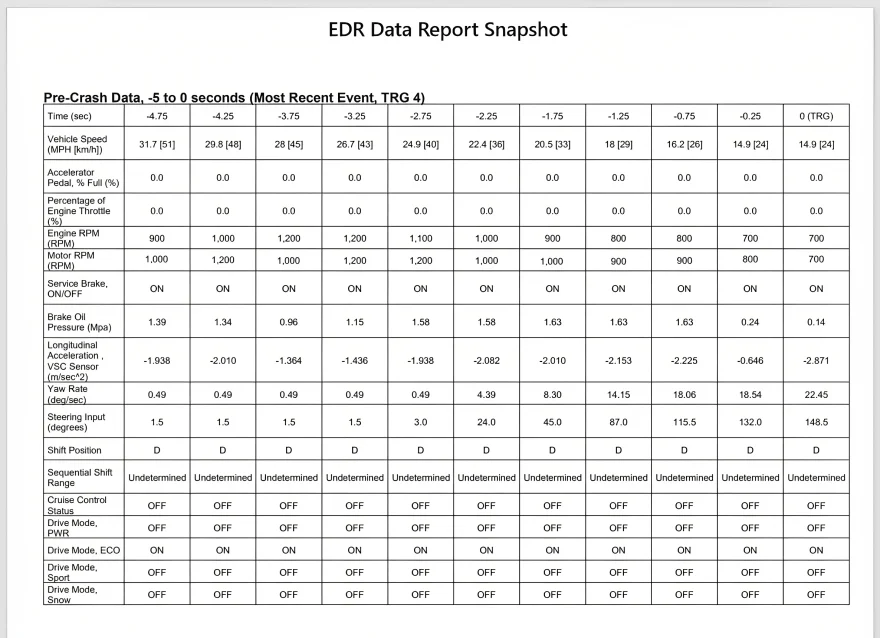
An Event Data Recorder stores short, crash-related snapshots such as vehicle speed (from wheel speed sensors), brake status, throttle, seatbelt usage, airbag deployment info, and acceleration/yaw rates.
Learn more: EDR Retrieval & Analysis Services.
What Is GPS Tracking Data?
GPS trackers compute speed from positional change via satellite signals. They’re excellent for route history and average speeds over distance. However, low logging frequency or signal issues can under-represent rapid, pre-impact speed changes.
Why EDR and GPS Speeds Can Differ
- Sampling rate: EDR logs multiple times per second; GPS commonly updates every 1–5 seconds.
- Data source: EDR uses wheel/drivetrain sensors; GPS uses positional change.
- Short spikes: A last-second acceleration or skid can appear in EDR but be missed by GPS.
- Environment: GPS accuracy drops in tunnels, dense urban canyons, or heavy foliage.
- Traction effects: Wheel slip or lockup can skew EDR-derived speed in specific conditions.
Legal & Insurance Considerations
Insurers and courts often give greater weight to EDR because it’s part of the vehicle’s safety system and is hard to tamper with. That said, credible GPS evidence remains valuable—especially when its sampling and signal context are explained by an independent expert.
What to Do When EDR and GPS Don’t Match
- Get an independent retrieval: Use approved tools (e.g., Bosch CDR, Hyundai/Kia GIT) to pull full EDR data.
- Time-align both sources: Normalize timestamps to the same clock.
- Review pre-impact windows: Identify any short spikes EDR captured.
- Document conditions: Road surface, tire size, ABS/ESC activity, and traction state matter.
- Engage counsel: If payout or liability hinges on speed, get legal advice early.
📞 +1 (940) 290-6052 | 📧 rmitchell@crodymi.com | Book a consultation
Related Reading
Frequently Asked Questions (EDR vs GPS)
Is EDR data more accurate than GPS?
Why would EDR show a higher speed than GPS?
Can EDR be wrong?
Can GPS be wrong?
Which source do insurers trust more?
Is EDR admissible in court?
Does EDR record without airbag deployment?
How far before a crash does EDR record?
How accurate is GPS speed in ideal conditions?
How accurate is EDR speed?
What’s the best way to reconcile EDR and GPS?
Can an expert challenge EDR readings?
Should I request the raw EDR file?
Will GPS logs help my insurance claim?
Who can analyze both EDR and GPS for my case?
We retrieve, interpret, and present EDR & GPS data for insurance disputes and litigation.
📞 +1 (940) 290-6052 | 📧 rmitchell@crodymi.com | Book a consultation
Get started
Start the process today — no upfront payment required. We’ll provide the service now, and you can settle the payment later.
Tell us what you need
Get updates & continue
Drop your email so we can follow up. You can skip if you prefer.