Get started

Start the process today — no upfront payment required. We’ll provide the service now, and you can settle the payment later.

Forensic Services that Win Cases

Data-driven investigations, courtroom-ready visuals, and expert reports—delivered fast and defensibly.

  • Turnaround: most services 1–7 business days
  • Satisfaction: at least 2 revisions on each project
  • Nationwide: on-site & remote service

Ready to move your case forward?

Get a fast, defensible deliverable—backed by clear methods and expert testimony.

Get started

Start the process today — no upfront payment required. We’ll provide the service now, and you can settle the payment later.

Frequently Ask Questions – Crodymi LLC

Frequently Ask Questions

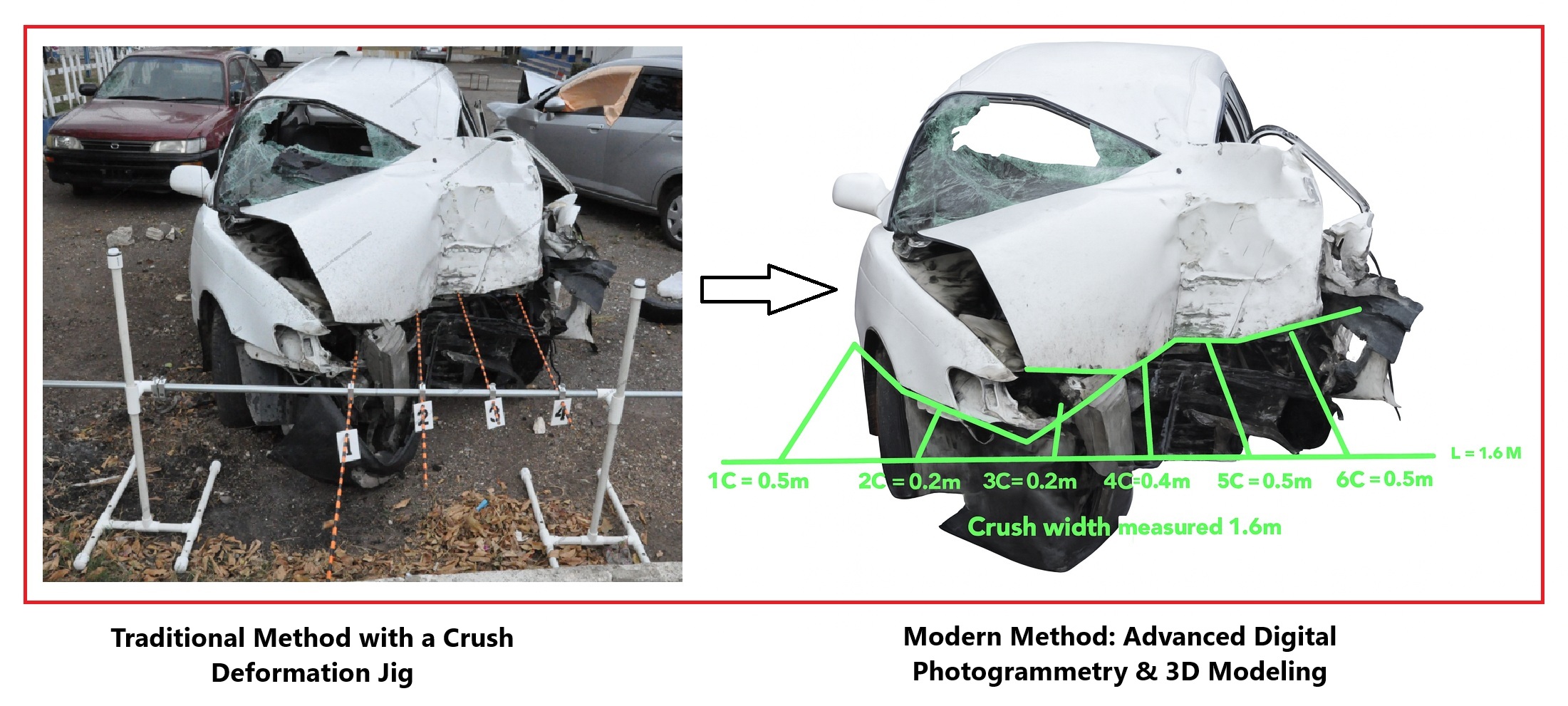
Yes. We routinely reconstruct crashes months or years later. We combine surviving physical evidence (vehicle condition, repair photos, police reports), authenticated digital media (CCTV/phone video, dashcam, bodycam), roadway geometry, and publicly available data (street view, satellite imagery, weather, sun position). Where applicable we analyze EDR “black-box” data, infotainment logs, and call detail records. If the scene has changed, we build a measured model using 3D scanning, photogrammetry, or scene mapping and reconcile it with historical imagery for a defensible result.
A fatal investigation is evidence-driven and methodical: 1) secure chain-of-custody and scene access; 2) document vehicles and roadway with LiDAR/3D scan and calibrated photography; 3) acquire EDR/ACM downloads and relevant infotainment data; 4) collect video (CCTV, dashcam) and synchronize by timecode/frame-rate; 5) perform speed, time-distance, visibility, line-of-sight, and perception-reaction analyses; 6) model vehicle dynamics and impact configuration; 7) prepare courtroom-ready exhibits/animations; 8) provide a peer-checked written reconstruction report with conclusions and limitations.
We measure the frame span between two identifiable positions (e.g., entry to impact). At 23.97 fps one frame ≈ 0.0417 s. Time = frames × 0.0417. Distance is scaled using surveyed control points, Google Maps/Street View triangulation, or site measurements. Speed = distance ÷ time (ft/s), then × 0.6818 for mph. We report uncertainty with ±1–2 frames and any lens/parallax corrections applied.
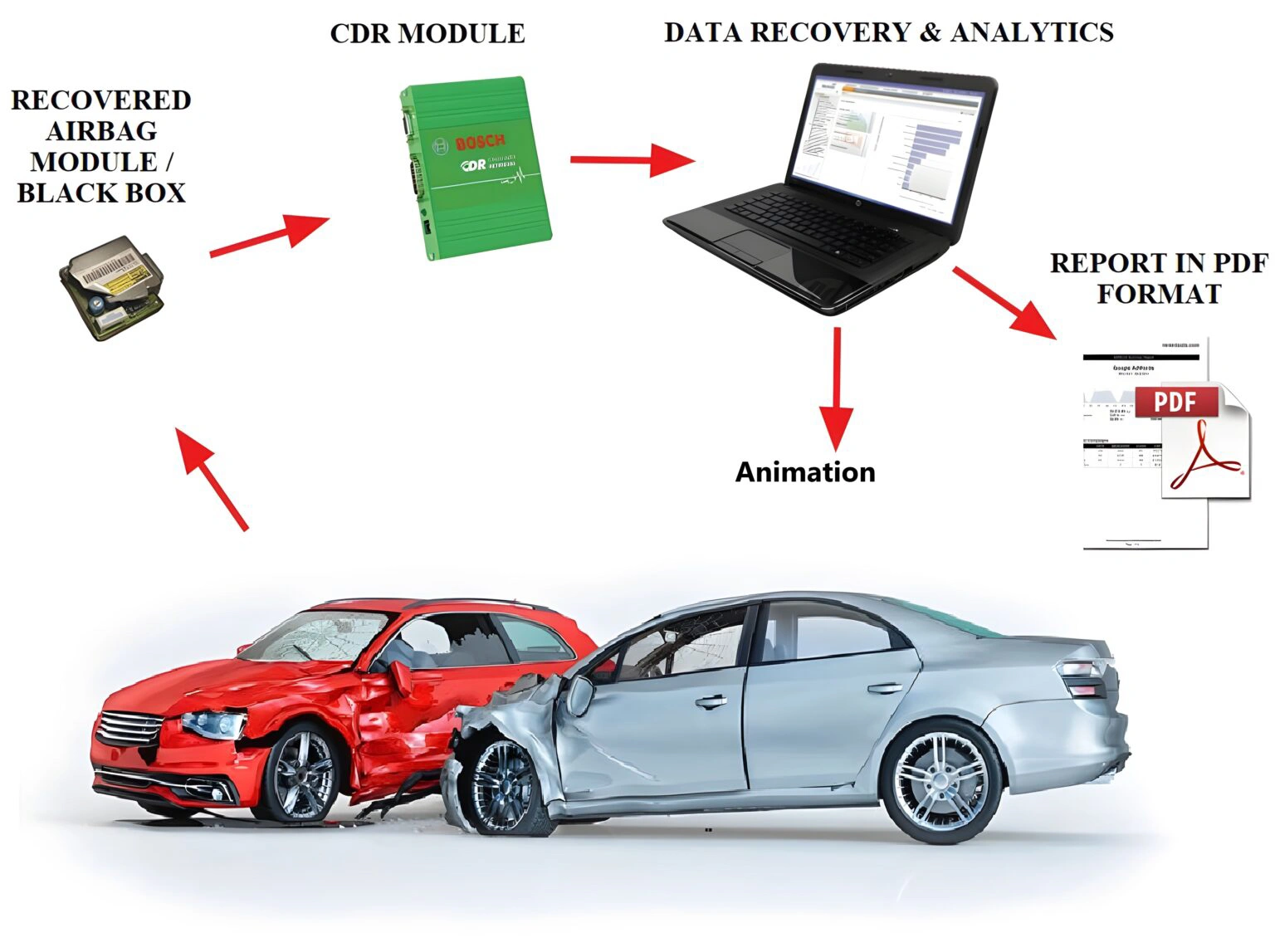
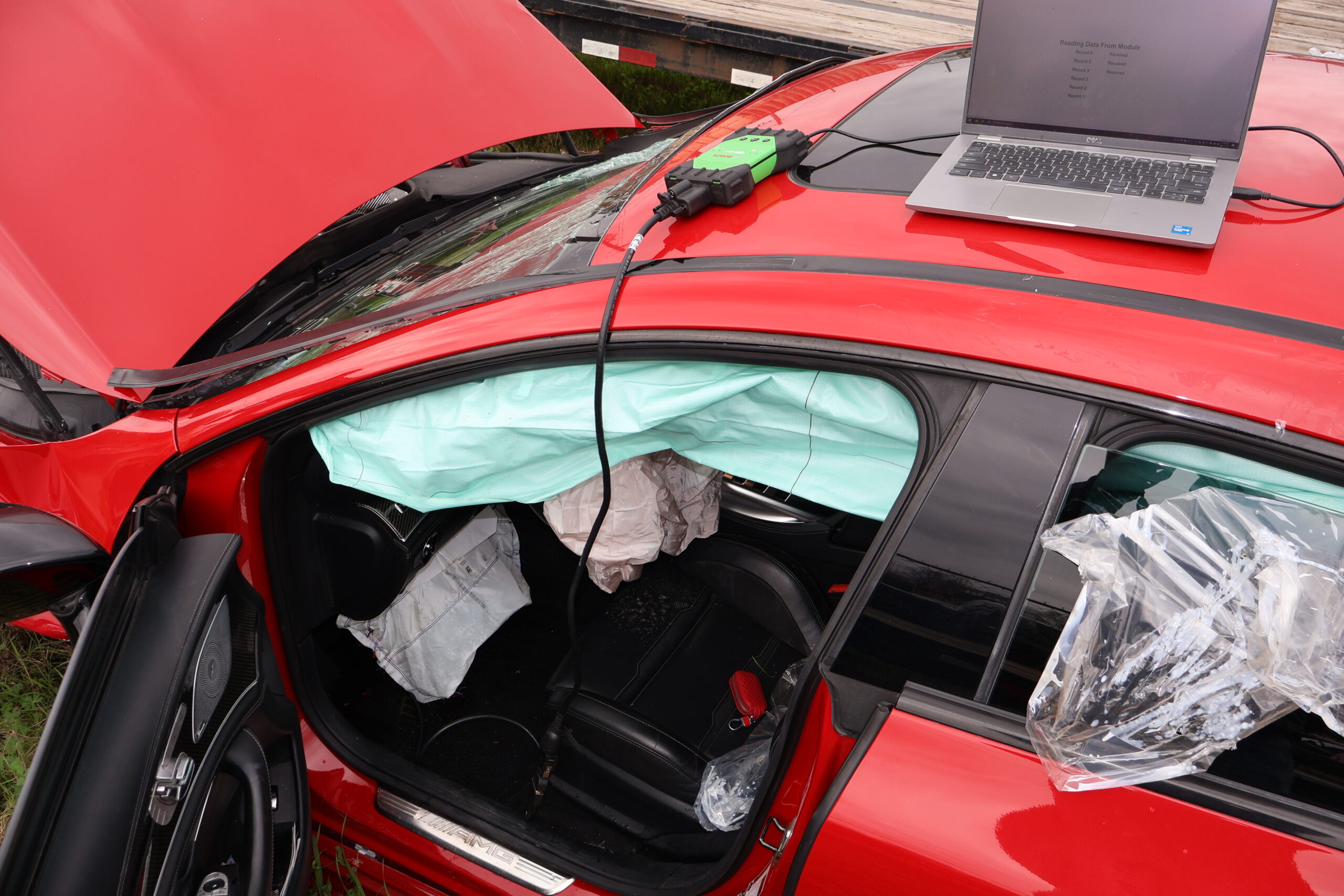
The Event Data Recorder inside the ACM/ECU stores pre-crash vehicle parameters (speed, throttle, brake, steering, delta-V, seat-belt status, airbag deployment). Properly collected with CDR/OEM tools and preserved with chain-of-custody, EDR provides a time-aligned, objective record that complements video and witness testimony. We also perform bench-level module repair when the vehicle won’t communicate via OBD-II.
Often, yes. If OBD-II access fails, we remove the module and attempt direct-to-module acquisition or board-level repair under lab conditions. We document every step (photos, metadata) and keep custody logs to preserve admissibility.
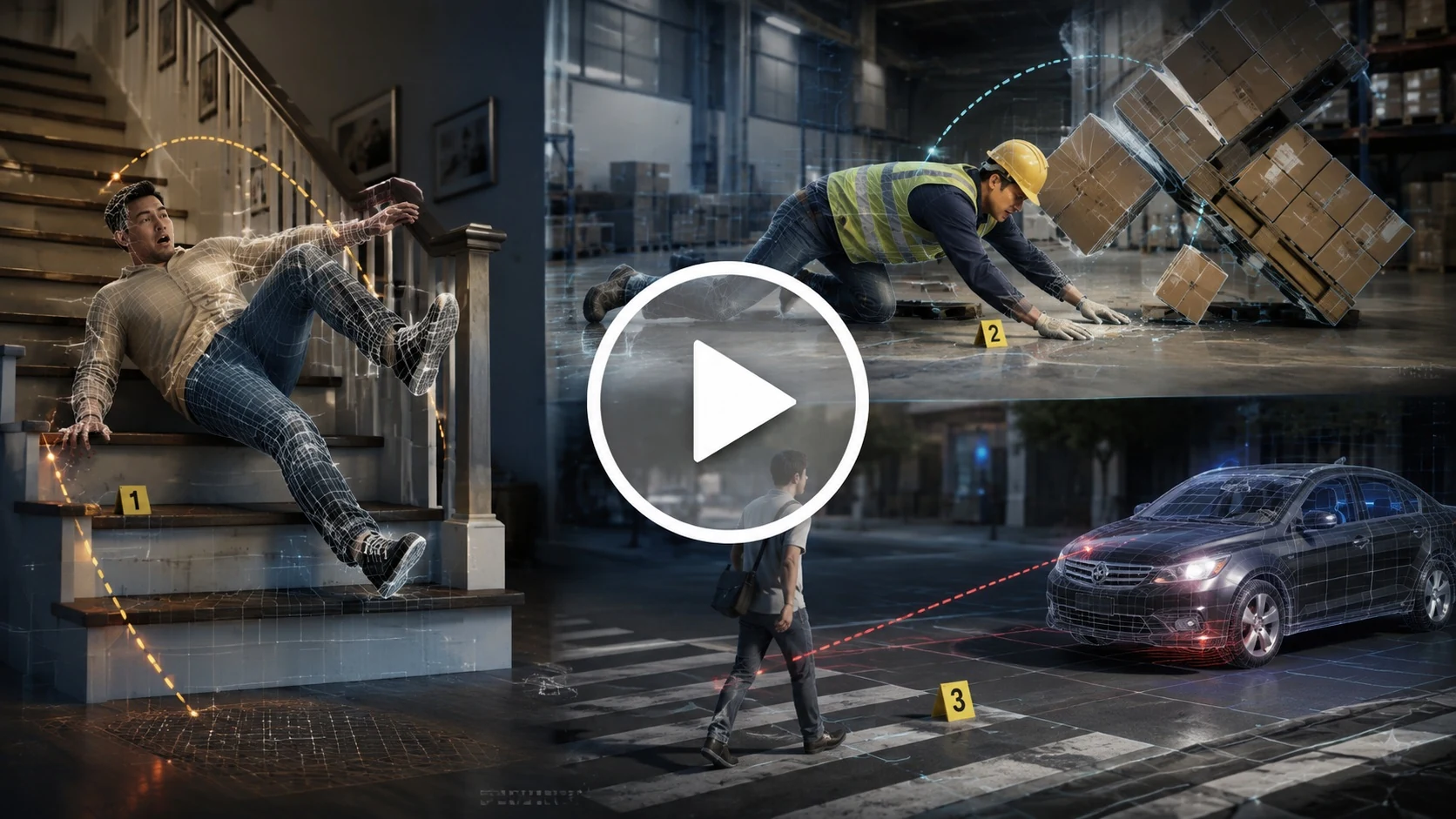
Our animations are demonstrative, not argumentative: they are grounded in measured geometry (LiDAR/photogrammetry), EDR/video timing, and physical constraints. We provide methodology, inputs, and uncertainty notes, and we maintain a clear audit trail so counsel can establish substantial similarity and reliability.
Scope letter, assumptions/limitations, evidence inventory, scene/vehicle documentation, EDR & infotainment results, video time-sync, calculations (speed, time-distance, line-of-sight, PRT), collision configuration and delta-V estimates, causation analysis, conclusions, and trial-ready figures/exhibits.
Yes—nationwide, on-site and remote. We can scan/map scenes and vehicles on location, or receive shipped modules for lab processing. We coordinate with tow yards, law enforcement, and counsel to minimize spoliation risk.
Typical turnaround is 1–7 business days for most services after evidence access. We offer rush/expedited timelines for hearings, depositions, or mediation. Complex reconstructions with multi-source video or heavy 3D modeling may require additional time; we provide a written schedule up front.
We provide a satisfaction guarantee that includes at least two revisions per project to ensure clarity and courtroom readiness. Our findings remain objective and independent; revisions refine communication, not conclusions.
Unique evidence IDs, tamper-evident seals as needed, transfer logs, cryptographic hashes for digital files, and read-only workflows. We preserve raw data, maintain processing notes, and provide metadata reports for all downloads and scans.
Yes. We align feeds by frame-rate, shutter phase, audio/visual events, GPS/phone time, or electrical flicker frequency. The result is a common timebase for accurate time-distance and visibility analysis across cameras.
We model occlusions (sign posts, canopy columns) using surveyed dimensions and camera pose. Sight-alignment and triangulation determine when objects become visible to a driver or a camera, supporting PRT and avoidability opinions.
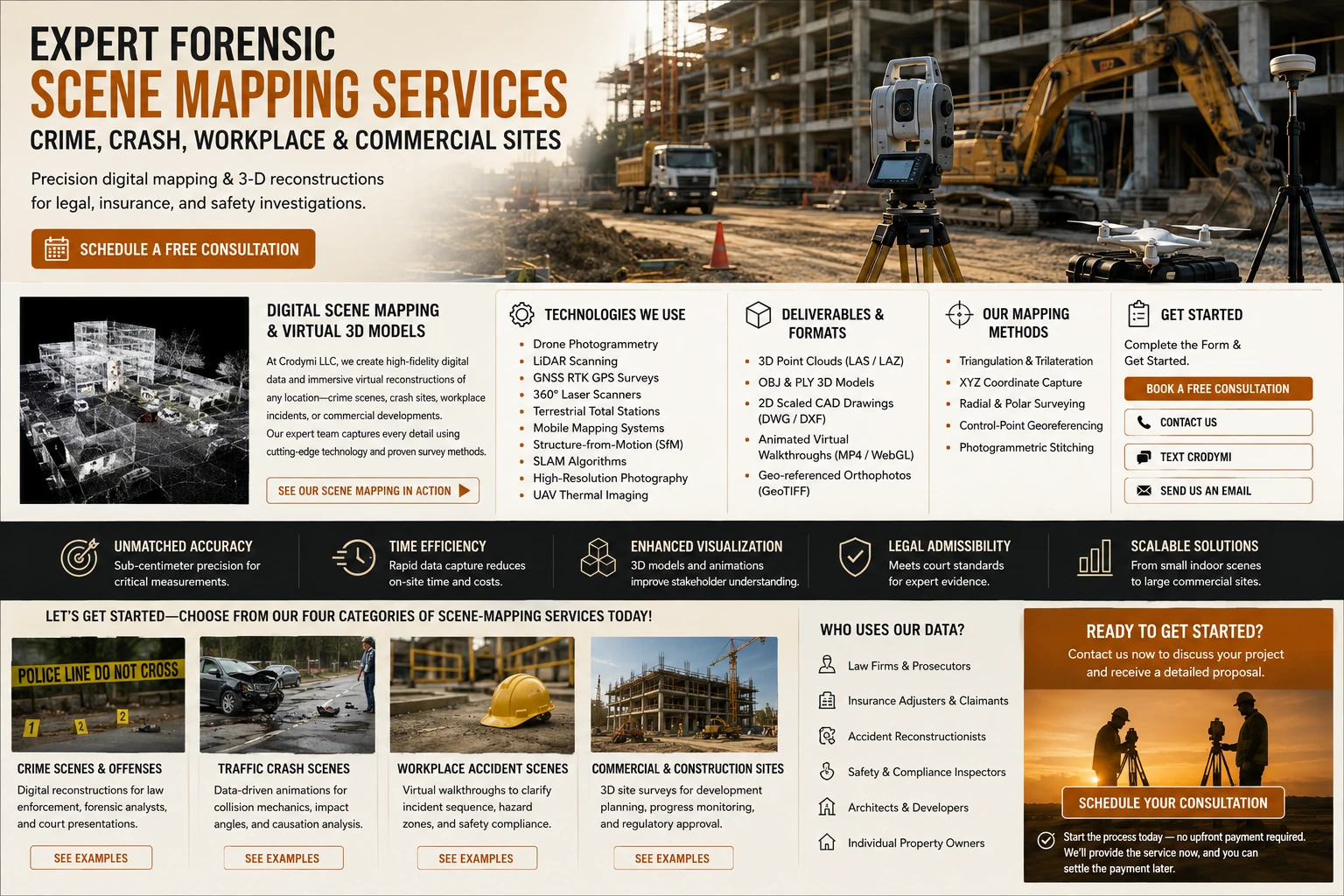
Yes. We deliver scaled drawings & sketches, total station/drone maps, and LiDAR point clouds suitable for exhibits and engineering review. Diagrams include lane widths, grades, sight lines, control devices, and evidence marks.
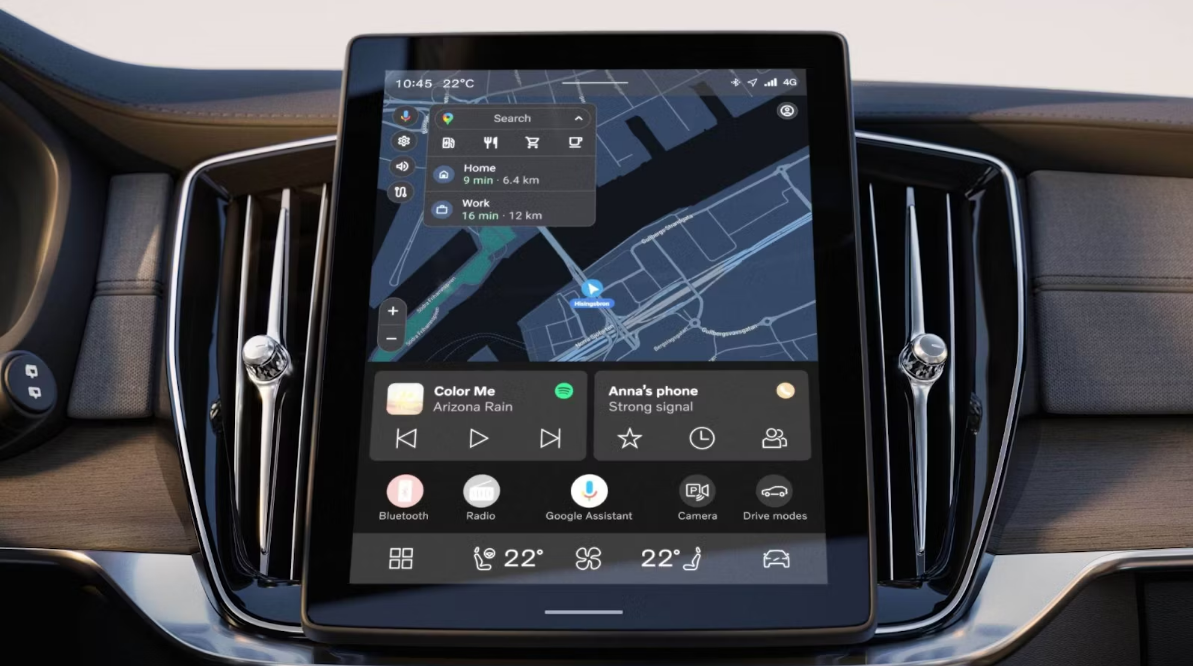
Yes. Infotainment systems can contain GPS breadcrumbs, call logs, paired devices, app usage, and media metadata. We extract and parse this information (when legally authorized) to corroborate timelines and vehicle movements.
We estimate delta-V using EDR data when available; otherwise, from speed, crush, and impact geometry with validated models. We discuss injury risk qualitatively using literature ranges (e.g., AIS 0–3 associations) while avoiding medical diagnosis.
A signed PDF report, appendices (photos, measurements, downloads), native data as appropriate, and optional 3D/animation exhibits in MP4 or stills. We can also supply expert testimony and demonstratives for mediation or trial.
Yes. We ingest CCTV/surveillance in native formats, stabilize as needed, extract accurate timestamps, and apply lens calibration to reduce distortion. We can also integrate UAS/drone imagery for aerial context and mapping.
LiDAR/structured-light scanning captures millimeter-level geometry of vehicles and scenes. It preserves evidence, enables repeatable measurements, and becomes the backbone for accurate animations and scaled exhibits.
In DFW we provide process serving with GPS/photo proof and Rule-compliant returns, including rush service and skip-tracing support when requested.
We scope to your deadlines and evidence access. Pricing may be fixed-fee for standard downloads/diagrams or phased for complex reconstructions (intake → capture → analysis → deliverables). You’ll receive a written estimate before we begin.
Yes. We are an independent forensic service. Our role is to objectively analyze evidence and communicate findings clearly—regardless of party.
Absolutely. We prepare courtroom-ready visuals, provide deposition/trial testimony, and support demonstratives (boards, prints, videos) that align with the underlying physics and documented methods.
Email or call with a short case summary, deadlines, and what evidence is available (vehicles, modules, photos, videos, reports). We’ll propose a scope, share an evidence checklist, and schedule site/vehicle access or module shipment to begin within 1–7 business days.
4.86
Average rating (last 100)

Get started

Start the process today — no upfront payment required. We’ll provide the service now, and you can settle the payment later.

Crodymi