
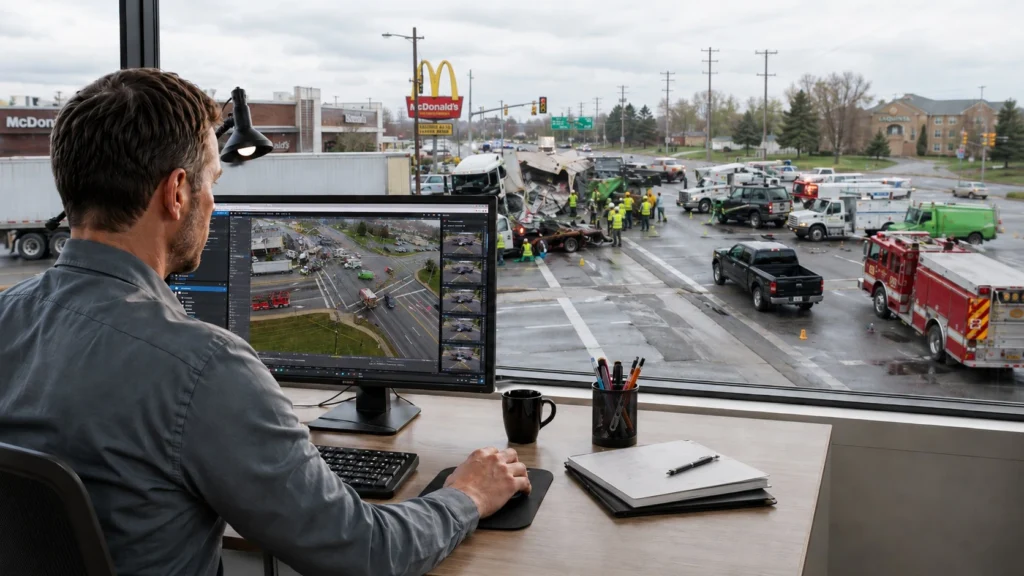
AI Is Changing Crash Scene Animation — But the Evidence Must Still Come First
Artificial intelligence is rapidly changing the way a forensic crash animation can be developed. Tasks that once required extensive manual modeling can increasingly be assisted by AI systems capable of interpreting photographs, roadway geometry, vehicle descriptions, environmental conditions, and other structured case information.
The real opportunity, however, is not simply creating a better-looking accident animation. The goal is to build an evidence-driven 3D crash reconstruction in which measurements, vehicle motion, timing, roadway geometry, and documented physical evidence constrain what the viewer sees.
This distinction matters. A visually impressive collision scene may be persuasive, but photorealism is not the same as forensic accuracy. The strongest modern workflow combines traditional accident reconstruction principles with artificial intelligence, digital scene mapping, vehicle data, photography, video analysis, and expert validation.
Recent research into AI-assisted traffic accident reconstruction is already moving in this direction. Instead of allowing an AI system to freely invent a collision, researchers are developing methods that constrain reconstruction using geometry, velocity, vehicle interaction, road topology, and collision consistency.
At Crodymi LLC, this evidence-first approach is central to our forensic traffic crash and accident animation services . The purpose of technology is not to replace the reconstruction evidence—it is to make that evidence easier to understand.
Research: Guan et al. (2026), “TRACER: Training-Free Closed-Loop Structured Inference for Traffic Accident Reconstruction.” View research .
From Prompting to Evidence-Conditioned Scene Generation
One of the most important developments in AI accident reconstruction is the ability to move beyond a generic text description and build a scene from structured forensic data. In practical terms, the AI should be given a digital description of the actual crash environment rather than being allowed to guess what the scene looked like.
That scene specification may incorporate documented information such as roadway width and curvature, lane configuration, traffic-control devices, vehicle dimensions, final-rest positions, impact areas, tire marks, crush measurements, GPS or RTK coordinates, photographs, surveillance video, drone imagery, LiDAR measurements, and photogrammetric models.
Vehicle information can add another layer. Where supported and properly retrieved, Event Data Recorder (EDR) or vehicle black box data may provide information associated with vehicle speed, braking, accelerator input, restraint systems, and other recorded parameters surrounding a crash event. Those measurements can be used as constraints when developing vehicle trajectories and timing within an accident reconstruction animation.
Physical Evidence & Digital Data → Measured Scene Geometry → Reconstruction Analysis → AI-Assisted Visualization → Expert Validation
This is why accurate scene documentation remains so important even as AI improves. Crodymi's forensic scene mapping services can preserve the geometry needed for a later 3D reconstruction, while our EDR black box data retrieval and analysis services help preserve available vehicle-event information.
Reference: The National Highway Traffic Safety Administration describes EDRs as devices that record information related to a vehicle event or crash. NHTSA Event Data Recorder information .
Photorealistic Does Not Automatically Mean Accurate
Generative AI can produce remarkably realistic vehicles, roadways, buildings, lighting, vegetation, weather conditions, surface textures, reflections, shadows, and environmental detail. This gives modern accident reconstruction animation the potential to look far more natural than many older computer-generated reconstructions.
But forensic work requires an important separation between visual realism and evidentiary accuracy. An AI system can create a convincing-looking skid mark, traffic sign, vehicle position, damaged component, pedestrian, or roadway feature even when that object was never documented in the evidence.
For that reason, AI-generated detail should be subordinate to the known evidence. Measured geometry should control geometry. Verified vehicle data should control vehicle behavior. Source photographs and video should control visible scene characteristics. Reconstruction calculations should control speed and motion when those calculations form the basis of the opinion.
The ideal result is therefore not simply an AI-generated crash video. It is a data-driven forensic visualization in which AI helps improve presentation, realism, efficiency, and visual clarity without silently changing the underlying facts.
This distinction is particularly important for attorneys, insurers, investigators, and expert witnesses because a demonstrative can become more persuasive as it becomes more realistic. Greater visual impact should therefore be accompanied by greater documentation and validation.
Technical reference: NIST has published guidance addressing the provenance, transparency, authentication, and risks associated with AI-generated and other synthetic content. NIST AI 100-4
When EDR Black Box Data Becomes Part of the Animation
One of the strongest uses of artificial intelligence in crash visualization may come from combining AI-assisted modeling with vehicle Event Data Recorder (EDR) evidence. Instead of estimating every aspect of vehicle movement from appearance alone, the reconstruction can incorporate available vehicle-recorded data into the timeline.
Depending on the vehicle and the recorded event, EDR or related electronic data may help establish parameters associated with vehicle speed, braking, accelerator application, restraint status, airbag deployment, and other vehicle-system activity. Those data points can then be evaluated alongside physical evidence, scene measurements, vehicle damage, video, witness information, and accepted reconstruction methods.
For animation purposes, the value is significant. A sequence can be constructed around a defined time scale so that vehicle movement is not simply chosen because it “looks right.” The animation can instead be compared against the underlying data and adjusted when the visual movement does not agree with the reconstruction.
This creates an important feedback loop: data constrains the animation, and the animation can expose inconsistencies in the proposed reconstruction. If a vehicle cannot physically cover the represented distance at the calculated speed and time, the visualization provides another opportunity to identify and correct the discrepancy.
Crodymi LLC provides both vehicle EDR / black box data retrieval and analysis and forensic accident reconstruction animation services , allowing vehicle data, crash analysis, and visualization to be developed as connected parts of the same technical investigation.
Source: NHTSA research has examined EDR pre-crash information including speed, brake application, and accelerator input. National Highway Traffic Safety Administration — Event Data Recorders
The Future Is Not AI-Only — It Is Evidence-Grounded AI
The future of forensic accident reconstruction animation is unlikely to be a choice between human experts and artificial intelligence. The more useful model is a hybrid one: machines assist with visualization, modeling, image interpretation, organization, and iterative scene development while qualified investigators and reconstruction professionals determine which facts, measurements, calculations, and assumptions are technically supportable.
A useful way to evaluate any future AI crash reconstruction is to ask four questions: Where did the data come from? What parts of the scene were measured? What parts were calculated? What parts were created only for visual context?
Those questions matter because the strongest forensic visualization should allow another qualified professional to trace the important elements of the animation back to their source. Road geometry may originate from LiDAR, photogrammetry, RTK measurements, or survey data. Vehicle behavior may be supported by EDR black box data, video analysis, physical evidence, or reconstruction calculations. Vehicle damage may be modeled from photographs and measurements. Lighting and environmental context may be recreated from documented scene conditions.
The goal of forensic animation should not be to make an uncertain theory look real. The goal is to make verified evidence easier to see, understand, test, and explain.
Crodymi LLC develops evidence-driven visualizations for attorneys, investigators, insurers, companies, and individuals who need complex technical information converted into a clear visual presentation. Learn more about our 3D forensic traffic crash animation services , our EDR and vehicle black box data retrieval services , or our expert accident reconstruction services .
Technical References and Further Reading
National Highway Traffic Safety Administration.
Event Data Recorder research and technical information.
NHTSA.
National Institute of Standards and Technology.
Artificial Intelligence Risk Management Framework: Generative Artificial Intelligence Profile,
NIST AI 600-1.
NIST.
National Institute of Standards and Technology.
Reducing Risks Posed by Synthetic Content, NIST AI 100-4.
NIST.
Guan, Y. et al. (2026).
TRACER: Training-Free Closed-Loop Structured Inference for Traffic Accident Reconstruction.
Research paper.
Crodymi LLC can combine crash-scene evidence, vehicle data, reconstruction analysis, and modern 3D visualization to help turn a complicated collision into an understandable technical presentation.
Discuss Your CaseGet started
Start the process today — no upfront payment required. We’ll provide the service now, and you can settle the payment later.
Tell us what you need
Get updates & continue
Drop your email so we can follow up. You can skip if you prefer.